

- Price-based alerts
- Indicator-based alerts (for any indicator on your chart)
- Custom indicator alerts (for your own indicators).
How to Set Up Alerts
There are two ways to set up alerts in TakeProfit platform: directly on the chart or through the Alerts dialog window.Setting up alerts through the Alerts dialog window
- Click the “Alerts” button in the top right corner of your workspace
- Click “New Alert”
- In the dialog window, configure the following basic parameters:
- Source: Choose between Price or Indicator (if available on the chart)
- Criteria: Select the conditions that will trigger the alert
- Target: Enter the specific value (price level or indicator parameter)
- Click “Add more” to create multiple alerts simultaneously in the same window.
Setting one condition on several symbols
The symbol control on the left of the form has two parts: the symbol itself, and a + that opens search. Pick as many instruments as you need in one go — with a single symbol the form shows its ticker, and with more than one the control becomes an N symbols button that opens the list, where any of them can be removed again. Saving creates one alert per symbol, all of them sharing the condition you configured once. If some of them can’t be created — running into your active-alert limit is the usual reason — the form stays open and only the failing cards show an error, so the alerts that did go through aren’t lost. Hitting the limit also opens the subscription upgrade window.Setting up alerts directly on the chart
There are several ways to create alerts right from the chart.- Click the bell icon that appears when hovering over the chart - this will automatically use the current price or indicator value
- Create alerts through the chart’s context menu (right click)
- Add alerts directly from the price scale.
Create Alerts (ALT+A)
Quickly open the alert dialog by pressing Alt + A.Creating Alerts via AI (MCP)
Connect TakeProfit’s Model Context Protocol (MCP) server to your AI assistant to build, change, or check your alerts instantly using simple prompts — configure conditions, toggle states, or review history in plain language, without opening a dialog.What You Can Ask the AI to Do
- Create & delete — “Set a price alert for Bitcoin at $65,000” or “Remove my old Ethereum alerts.”
- Edit & toggle — “Pause my current SOL alerts” or “Change my target alert level.”
- Review & filter — “Show me all active alerts I have on tech stocks” or “List the alerts that triggered this morning.”
- Check history — “Pull up my trigger log from yesterday to see what went off.”
- Alert on your own indicator — “Alert me when my saved ATR Bands indicator crosses its upper band on BTC/USDT.”
An alert can be set on a private indicator of your own as soon as it is saved to My scripts. Publishing it to the Marketplace is not required. The assistant can also write and save that indicator for you in the same conversation — see Working with your platform data.
Core MCP Tools for Alerts
TakeProfit_CreateAlert: Create a new alert with specified parameters.TakeProfit_GetAlert: Retrieve details for a specific alert by ID.TakeProfit_UpdateAlert: Modify the parameters of an existing alert.TakeProfit_DeleteAlert: Permanently remove an alert from your workspace.TakeProfit_ListAlerts: View all of your alerts with custom filtering.TakeProfit_SetAlertState: Quickly pause, resume, or reset an alert.TakeProfit_PreviewAlert: Preview alert rendering without creating it.
Advanced Utilities
TakeProfit_GetUserAlertLog: Retrieve your historical alert trigger log.TakeProfit_GetAlertSchema/TakeProfit_GetAlertDocs: Access technical schemas and documentation directly inside the AI interface.
Additional settings
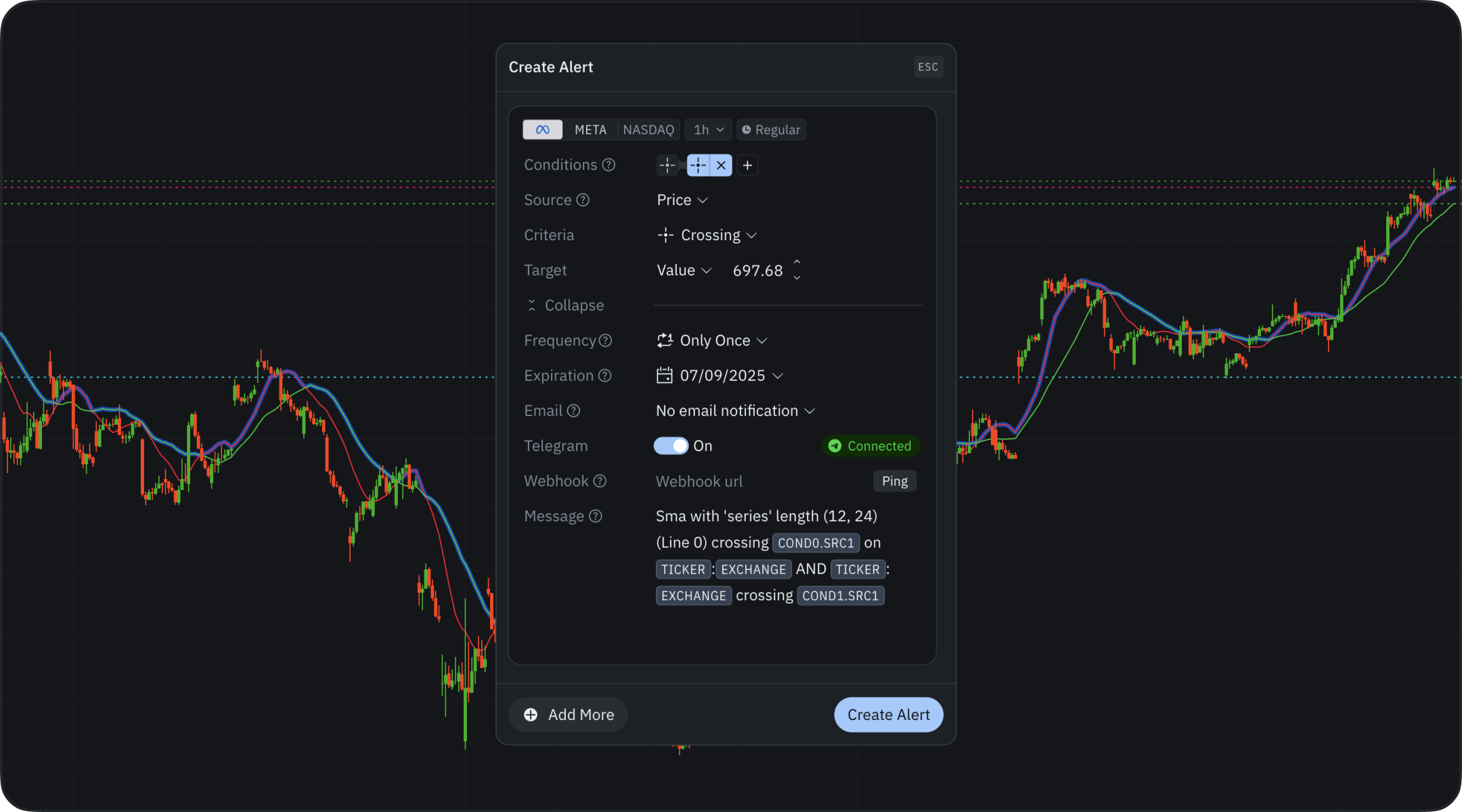
- Frequency settings
- Expiration date
- Email address for notifications
- Telegram - toggle to activate sending notifications to Telegram messenger
- Webhook URL for automated integrations
- Message field for customizing text with variable support.
Multiconditional Alerts
You can define multiple conditions within a single alert using the Add Condition button in the Alerts dialog window. Each condition in the group is evaluated together, meaning the alert will only trigger when all specified criteria are met. This allows you to:- Monitor several price levels for the same instrument
- Set alerts for multiple indicators at once
- Combine different alert types (e.g., price + indicator) in a single form
Alerts Tab in Chart Settings
When working with charts, you can access additional alert configuration options directly from the chart widget. In the chart settings, you’ll find a dedicated Alerts tab that provides the following customization options:- Alerts Lines: Toggle this option to display or hide alert lines on your chart (enabled by default). When active, this makes it easier to visualize where your alerts are positioned on the price scale.
- Inactive Alerts: This setting allows you to show or hide alerts that are currently inactive. By default, this option is disabled, showing only active alerts.
- Show Ticker: When enabled (default setting), this option displays the ticker symbol alongside your alert indicators, making it easier to identify which instrument each alert belongs to.